

Understanding your onboarding program’s current state, defining your desired state, conducting a gap analysis, and building a defensible business case are all critical steps in establishing an intentional onboarding strategy (Davila & Pina-Ramirez, 2018). These activities create the foundation, but they do not answer the most important design question:
What actually makes onboarding effective?
Fortunately, decades of research across organizational psychology, human resources, and talent development point to several consistent, evidence-based design elements.
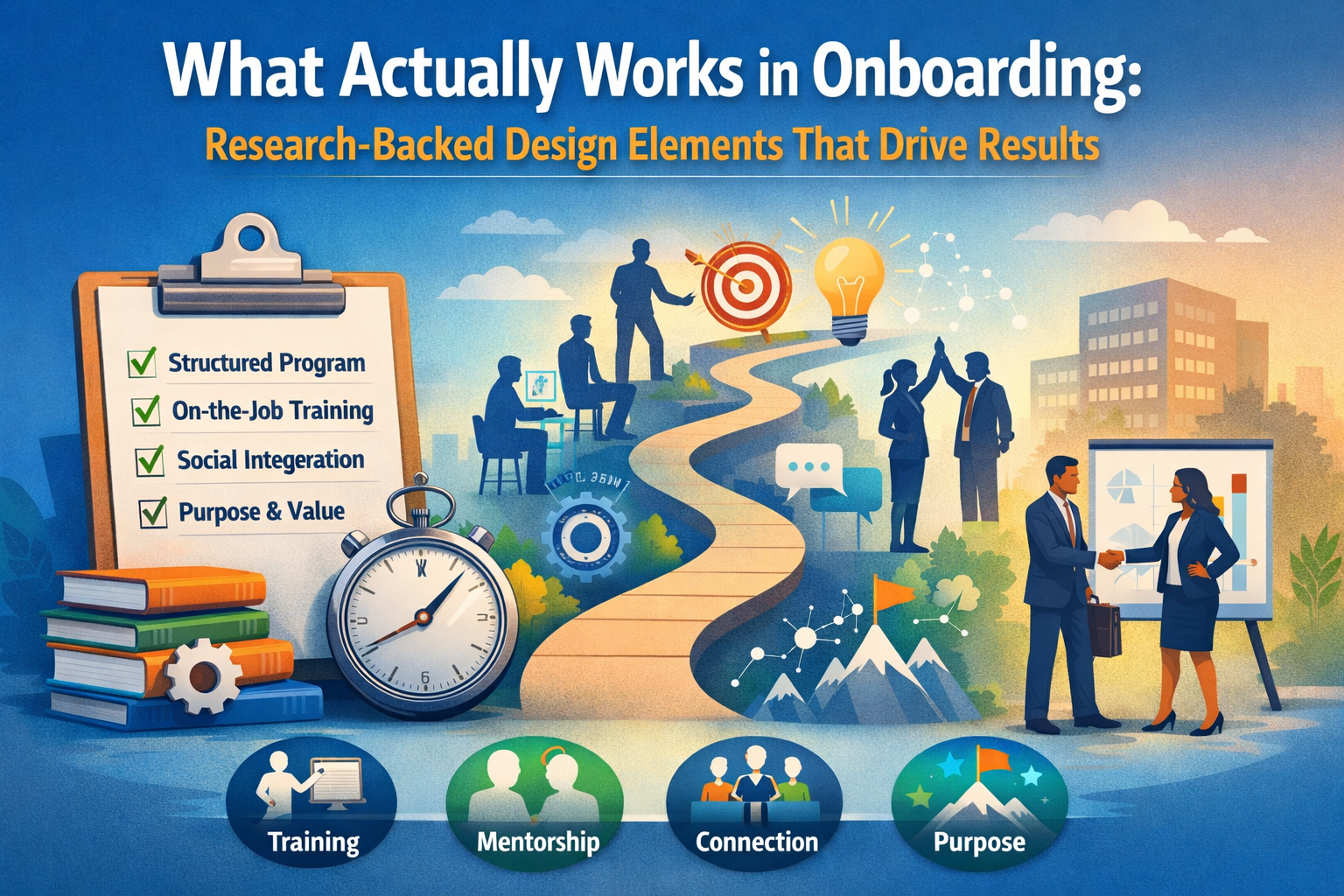
1. Structured and Formal Programs Outperform Ad Hoc Approaches
Research consistently shows that structured onboarding programs, those that extend beyond paperwork and a one-day orientation, produce stronger outcomes than informal “sink-or-swim” approaches.
Formal onboarding that includes defined curricula, extended timelines, and sequenced activities leads to improved role clarity, stronger job attitudes, higher organizational commitment, and lower turnover. Programs that intentionally scaffold learning and socialization consistently outperform unstructured, informal introductions, including findings summarized by Gallup.
Early in my career, I experienced one of the most thoughtfully designed onboarding programs I have encountered. It was blended, intentional, and critically, my supervisor fully understood and adhered to the process. Unsurprisingly, I excelled quickly, met performance goals early, and felt supported and fulfilled in the role.
Practical takeaway:
Design onboarding as a curriculum that unfolds over weeks or months, not a single orientation event.
2. On-the-Job Training and Practical Skill Building Are Highly Effective
Evidence strongly supports onboarding approaches that emphasize structured, supported on-the-job training.
A systematic review of onboarding research found that programs centered on guided practice and real work tasks produce stronger role clarity and competence development, often outperforming socialization strategies alone (PubMed Central).
At the same organization referenced above, role-based training allowed time to shadow experienced colleagues, ask questions, practice skills, and receive feedback before being expected to perform independently. Expectations were stable and clearly defined, which enabled learning to translate directly into performance.
Practical takeaway:
Build onboarding timelines that include mentor-led training, guided practice, feedback loops, and early exposure to real work.
3. Social Integration and Relationship Building Matter
Multiple studies highlight socialization as a core driver of onboarding success. Helping new hires build relationships with peers, managers, and the broader organization reduces uncertainty and accelerates adjustment.
Research shows that onboarding experiences that include manager welcome, coworker support, and access to well-being resources reduce turnover intentions by improving psychological and workplace well-being (Springer). Activities that foster connection and belonging also predict long-term engagement and adaptation (Penn Digital Repository).
In my experience, being paired with a genuine onboarding “buddy”, someone invested in my success, made a measurable difference in how quickly I acclimated and felt confident navigating the organization.
Practical takeaway:
Embed formal buddy programs, peer introductions, and regular manager check-ins into your onboarding design.
4. Connecting Individual Value to Organizational Purpose Boosts Outcomes
Onboarding is most effective when it helps new hires understand not only what they do, but why their contribution matters.
Organizational psychology research, notably work by Dan Cable and colleagues, shows that onboarding approaches encouraging employees to express strengths, values, and identity lead to higher engagement, performance, and retention. While there is ongoing debate about the idea of “bringing your whole self to work,” workplaces that value people without requiring identity performance are consistently healthier and more sustainable.
Practical takeaway:
Design early onboarding activities that invite new hires to share strengths, aspirations, and ideas, and explicitly connect those to organizational goals.
Operationalizing Onboarding: Models and Measures That Matter
Several established models help translate research into practice. One widely used framework is Tayla Bauer’s 6 C’s of Onboarding, which links onboarding design to measurable outcomes:
- Compliance: understanding rules and policies
- Clarification: role expectations and success criteria
- Confidence: self-efficacy and competence
- Connection: relationships and belonging
- Culture: norms, values, and ways of working
- Check-back: feedback and continuous adjustment
This framework supports both program design and evaluation by aligning onboarding components to performance, engagement, and retention metrics.
Showing Value: What Effective Onboarding Must Deliver
In Effective Onboarding: What Works in Talent Development, Davila and Pina-Ramirez (2018) explained that onboarding demonstrates value when it intentionally:
- Explains organizational culture
- Supports employees in meeting role expectations
- Communicates mission, vision, and values
- Reduces turnover
- Increases employee engagement
To assess readiness, they recommend asking:
- How does your organization define onboarding?
- Why is onboarding important to your organization?
- Who are the stakeholders of your onboarding program?
- Does your organization differentiate between employee orientation and employee onboarding?
- What is your organization doing to ease the transition of new employees into its culture?
- What is your organization doing to assist employees as they assume new roles and perform new functions?
- What happens between the moment an offer is accepted and an employee’s first day?
- How does the organization handle differences in background and experience during onboarding?
- How are promotions, lateral moves, transfers, or demotions addressed through onboarding?
Final Thought
Producing an onboarding program that delivers results requires intentional design, sustained effort, and organizational commitment, but the payoff is significant. Strong onboarding builds capability faster, improves retention, and strengthens culture. The evidence is consistent: organizations that approach onboarding as a system, rather than a standalone event, see stronger outcomes.
Resources & References
Bauer, T. N. (2010). Onboarding new employees: Maximizing success. SHRM Foundation.
https://www.shrm.org/foundation/ourwork/initiatives/resources-from-past-initiatives/onboarding-new-employees
Bauer, T. N., Bodner, T., Erdogan, B., Truxillo, D. M., & Tucker, J. S. (2007). Newcomer adjustment during organizational socialization: A meta-analytic review of antecedents, outcomes, and methods. Journal of Applied Psychology, 92(3), 707–721.
https://doi.org/10.1037/0021-9010.92.3.707
Cable, D. M., Gino, F., & Staats, B. R. (2013). Breaking them in or eliciting their best? Reframing socialization around newcomers’ authentic self-expression. Administrative Science Quarterly, 58(1), 1–36.
https://journals.sagepub.com/doi/10.1177/0001839213477098
Davila, A., & Pina-Ramirez, W. (2018). Effective onboarding: What works in talent development. Association for Talent Development (ATD).
https://www.td.org/books/effective-onboarding-what-works-in-talent-development
Gallup. (2019). Creating an exceptional onboarding journey for new employees.
https://www.gallup.com/workplace/235121/creating-exceptional-onboarding-journey-employees.aspx
Klein, H. J., & Polin, B. (2012). Are organizations onboard with best practices onboarding? In C. R. Wanberg (Ed.), The Oxford handbook of organizational socialization. Oxford University Press.
https://doi.org/10.1093/oxfordhb/9780199763672.013.0011
Klein, H. J., Polin, B., & Leigh Sutton, K. (2015). Specific onboarding practices for the socialization of new employees. International Journal of Selection and Assessment, 23(3), 263–283.
https://doi.org/10.1111/ijsa.12113
Penn Digital Repository. (2016). Organizational socialization and newcomer adjustment.
https://repository.upenn.edu/od_theses_msod/87/
PubMed Central. (2020). Organizational socialization and onboarding practices: A systematic review.
https://www.ncbi.nlm.nih.gov/pmc/articles/PMC7358655/
Springer. (2021). The impact of onboarding practices on employee well-being and turnover intention. Current Psychology.
https://link.springer.com/article/10.1007/s12144-021-02105-9
 Dr. Treca Bourne