

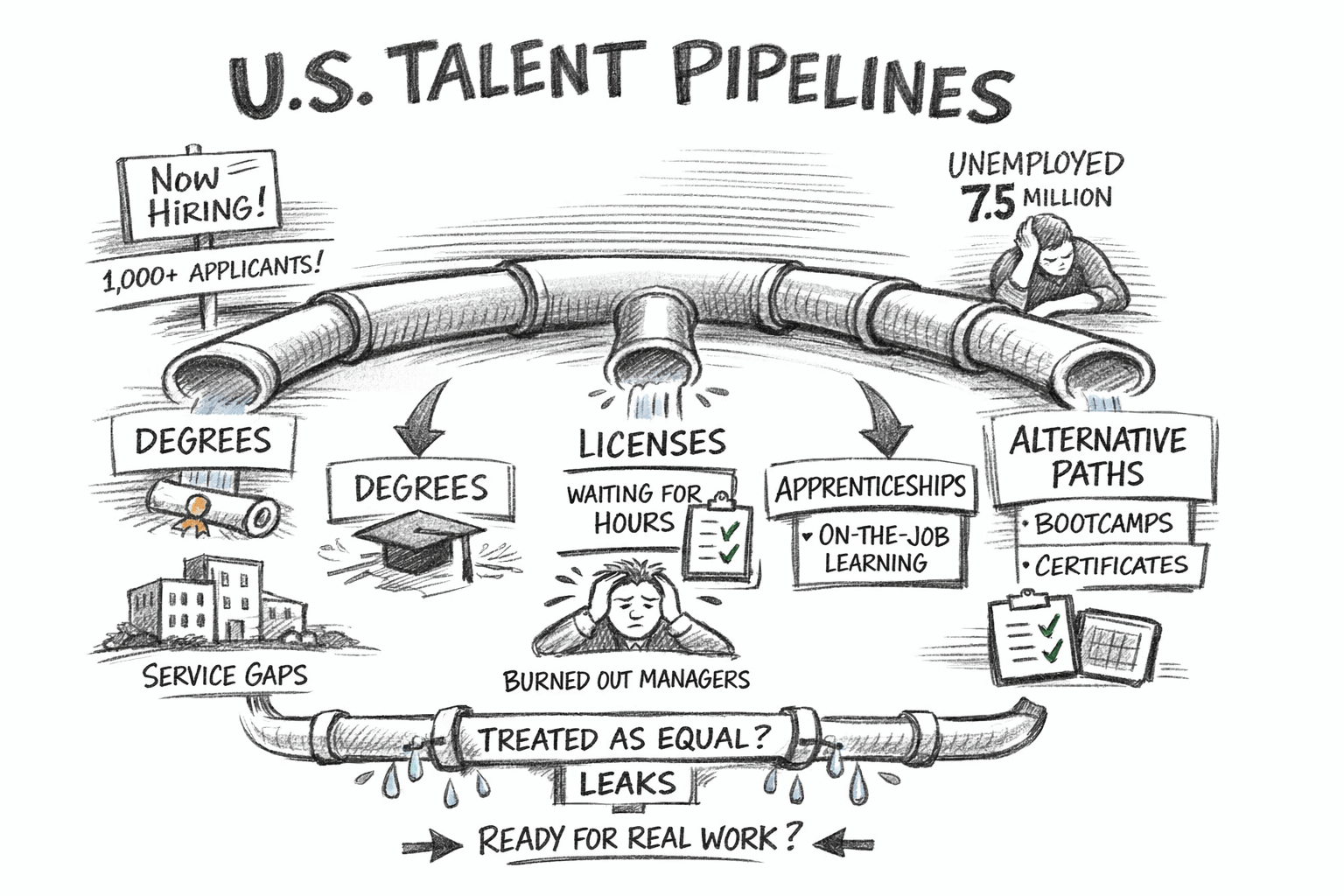
There is no shortage of talent in the United States right now. On LinkedIn and other hiring platforms, jobs often attract hundreds or even thousands of applicants, indicating that many people are actively seeking work. According to the U.S. Bureau of Labor Statistics, roughly 7.5 million people were unemployed and seeking work in December 2025. The official unemployment rate was 4.4 percent, a small decline from the prior month but still representing a large pool of job seekers.
At the same time, job openings have declined, falling to around 7.1 million in late 2025. This shift means there are more people looking for work than available positions in some segments of the market.
Underneath these labor market numbers is a deeper story about ungoverned talent pipelines.
In the U.S., talent pipelines follow familiar paths:
- Degrees
- Community colleges
- Licensure
- Apprenticeships
- Internal promotion
- Newer alternative credentials
Each of these was originally designed to solve a specific workforce problem. None was intended to operate independently or to substitute for one another. The challenge arises when organizations treat these pipelines as interchangeable. For example:
- Degrees are assumed to signal readiness for work
- Licensure is mistaken for actual day-to-day competence
- Onboarding is expected to make up for years of underprepared entry
- Individuals are left to bridge systemic gaps on their own
These assumptions contribute to persistent disconnects between available talent and employer expectations.
Short Case: Healthcare Entry Pipelines
In clinical and allied health fields, licensure is essential for public safety. Yet many graduates face long waits for supervised practice or clinical hours before licensure, creating bottlenecks that delay entry into the workforce. Meanwhile, hospitals report high numbers of applicants for entry positions but struggle to find candidates with real readiness to perform complex tasks on day one.
Short Case: Tech Hiring and Alternative Credentials
In technology roles, employers have experimented with boot camps and skills-based hiring. LinkedIn’s Economic Graph research shows that job seekers now submit roughly twice as many applications per job compared with pre-pandemic patterns, even though the number of job listings appears similar. This suggests growing competition and shifting expectations around skills and fit.
In regulated, mission-critical environments such as health care, behavioral health, and public services, pipeline breakdowns create very real consequences. When time-to-competence is long and early-career support is weak, the result can be:
- Service instability
- Supervision overload
- Employee burnout
- Increased compliance risk
At the same time, some industries face legacy issues tied to talent shortages stemming from demographic shifts, automation, and structural changes in labor demand.
The question becomes how to design pipelines intentionally so that they are fit for purpose rather than treated as interchangeable. They must do more than channel people in or out of roles. They must:
- Connect quality entry design to real job expectations
- Support sequenced capability development over time
- Prepare supervisors to develop competence on the job
- Enable real transfer of learning into performance
Effective pipelines are governed, not improvised. They recognize that readiness is built through supported exposure to complexity and not merely through credentials.
If organizations stop taking shortcuts, stop assuming readiness based only on signals like degrees or certifications, and start understanding what each pipeline can realistically deliver, the result is transformational.
The Outcome
People are not rushed into roles for which they are unprepared, managers are not left carrying invisible development burdens, and organizations gain something far more valuable than speed: reliability in performance and service delivery.
References
LinkedIn Economic Graph. (2024). Labor market tightness and job competition.
https://economicgraph.linkedin.com/blog/labor-market-tightness-linkedins-measure-of-job-competition
U.S. Bureau of Labor Statistics. (2026). Employment situation summary. U.S. Department of Labor.
https://www.bls.gov/news.release/empsit.htm
U.S. Bureau of Labor Statistics. (2025). Job Openings and Labor Turnover Survey (JOLTS). U.S. Department of Labor.
https://www.bls.gov/jlt/
U.S. Bureau of Labor Statistics. (2025). Unemployment level and rate.
https://www.bls.gov/charts/employment-situation/civilian-unemployment.htm
 Dr. Treca Bourne