

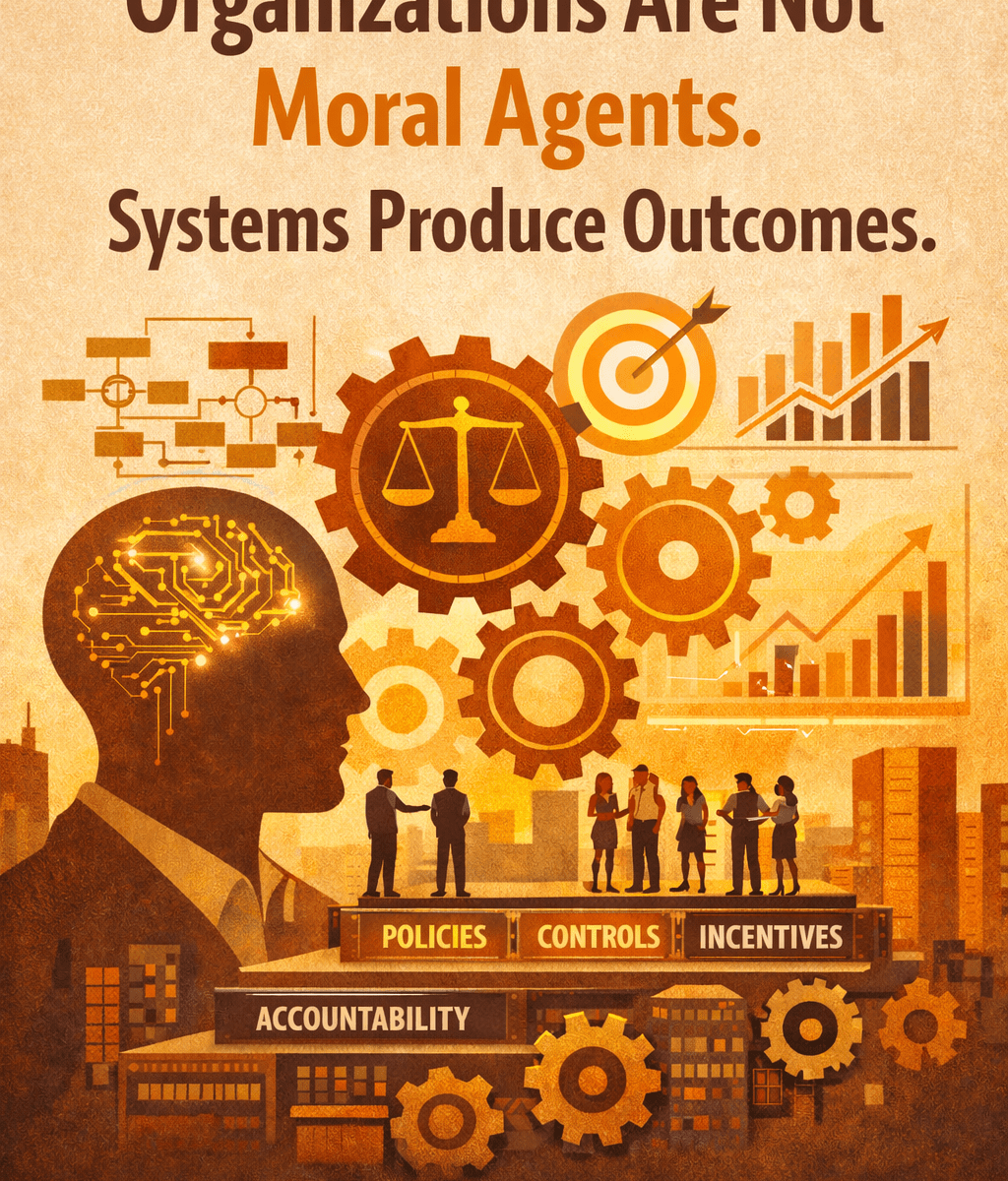
In organizational theory, management ethics, and sociology, there is broad agreement that organizations are not moral agents. Put differently:
- Organizations are not moral actors.
- Organizations do not have moral agency; people do.
- Organizations are amoral systems, not moral beings.
- Institutions are not moral entities; they are instruments.
Only individuals possess moral intent, conscience, and accountability. Organizations, by contrast, are:
- Structured systems of roles, incentives, processes, and constraints.
- Designed to pursue defined purposes such as mission, outputs, survival, efficiency, and compliance.
- Incapable of moral reasoning in the human sense.
As a result, an organization cannot “be ethical” or “care” in the way a person can. It can only produce behaviors that reflect the choices embedded in its governance, incentives, leadership decisions, and operating rules.
This is why scholars often describe organizations as “amoral systems that generate moral consequences.” Organizations do not possess morality, but they absolutely shape outcomes that affect people ethically, socially, and materially.
The organization’s job, then, is not to be moral; it is to function. When we expect organizations to behave like moral individuals, several predictable issues emerge:
Misplaced accountability
For example, “The organization failed,” instead of examining decision rights, incentives, and structural design.
Naive leadership expectations
For example, “If we hire good people, articulate strong values, and model the right behaviors, the organization will naturally do the right thing.” In reality, culture does not override incentive structures, workload capacity, regulatory pressure, resource constraints, decision rights, process overhead, or skill gaps.
Poor governance design
For example, unclear ownership for key decisions, overlapping authority, unnecessary escalation or decision avoidance, and conflicting direction to staff.
What we can do is deliberately design ethical behavior into the system through:
- Incentives
- Controls
- Decision rights
- Transparency
- Accountability mechanisms
- The capability and judgment of the humans operating within the system
Bottom line: Organizations lack moral agency; responsibility rests with individuals and governance systems. Ethical outcomes are the result of how well the system itself is designed.
 Dr. Treca Bourne