

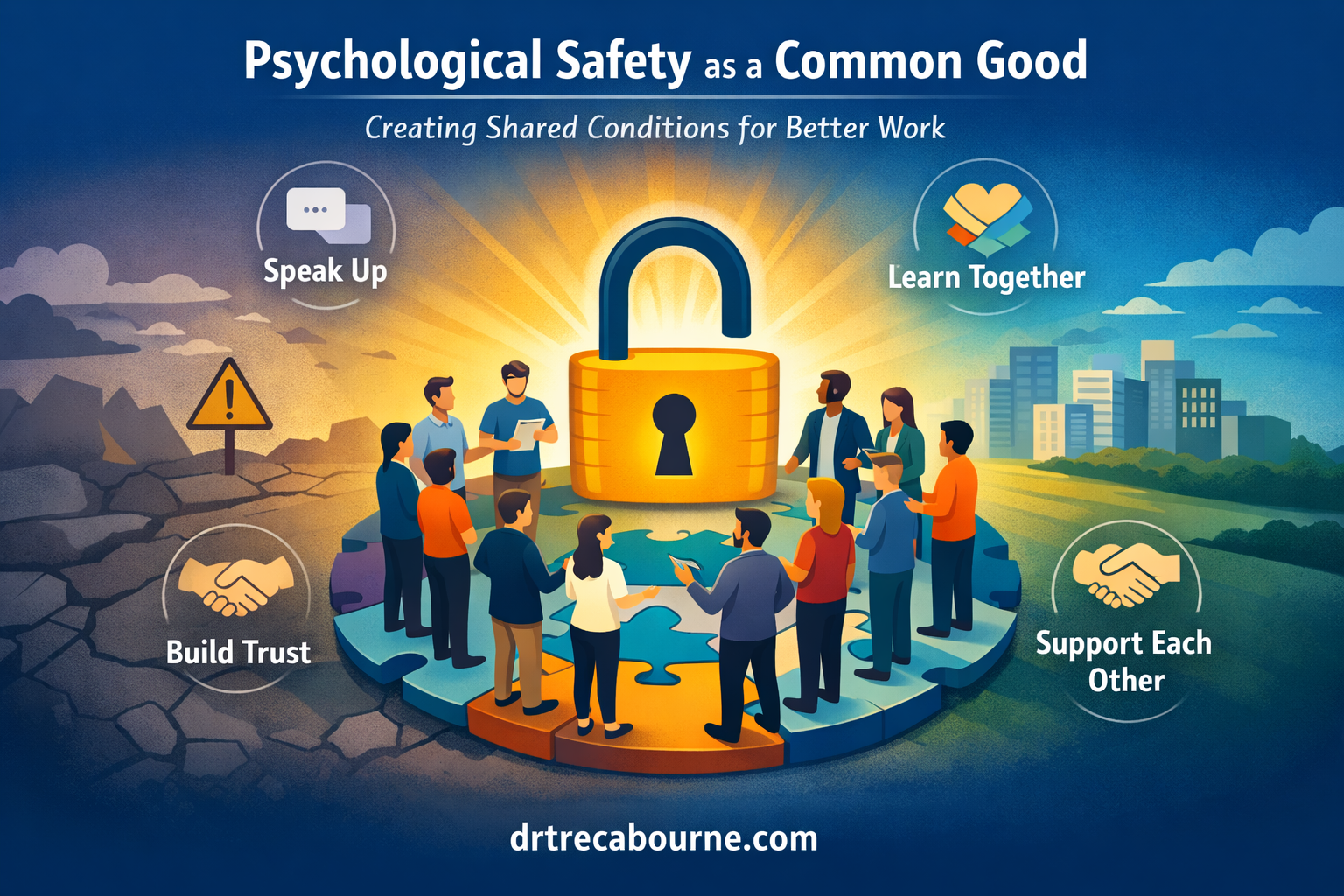
Psychological safety is usually described as a shared belief that it is safe to speak up, ask questions, admit mistakes, or raise concerns without fear of embarrassment or retaliation.
But in workplaces where the environment communicates scarcity, threat, or instability, psychological safety can start to feel like a limited resource that people must individually secure and protect rather than something the group holds collectively. That is what “competing for psychological safety” refers to.
When safety feels scarce, people begin to treat it like currency, something to guard, trade, or conserve. This shifts psychological safety from a collective condition to an individual strategy.
What Competing for Psychological Safety Looks Like in Practice
Careful impression management becomes a shield
“If I ask a question, I might look unprepared. Better to stay quiet.”
Employees distance themselves from those under scrutiny
“If I’m associated with them, I might lose status or be questioned too.”
Speaking up becomes personally risky
“If I challenge this decision, I might be labeled difficult and lose opportunities.”
Silence becomes a survival strategy
“It’s safer not to be noticed.”
In this environment, the ability to feel safe is not shared. It becomes something individuals try to gain for themselves by aligning with power, avoiding risk, or distancing from those perceived as unsafe.
Instead of psychological safety functioning as a common good, it becomes a private good that people protect, and sometimes even withhold from others, in order to preserve their own standing.
A Behavioral Economics Lens: Scarcity Shifts Behavior
This shift mirrors a core pattern in behavioral economics: When a resource feels scarce, people adopt strategies to maximize their personal access to it. Even when psychological safety could be shared, scarcity cues, whether real or perceived, drive competition.
• If safety feels fragile, people defend it.
• If access feels conditional, people perform for access.
• If stability feels uncertain, people minimize exposure.
The result is predictable: less candor, fewer questions, weaker collaboration, and limited learning. These are the very outcomes psychological safety is meant to prevent.
If We Want Shared Safety, We Must Design for It
Psychological safety cannot rely on good intentions alone.
To shift from competition to contribution, the organization must intentionally create conditions where safety is produced together, not individually earned.
This requires structures and practices that:
1. Reduce the perceived cost of speaking up
Normalize learning behaviors. Model fallibility. Reward inquiry.
Reduce the real and imagined penalties of candor.
2. Increase the shared benefit of candor and collaboration
Demonstrate how collective sense-making improves outcomes.
Make learning visible and valued across roles, levels, and teams.
3. Build systems where safety is generated collectively
Move beyond psychological safety as sentiment toward
psychological safety as infrastructure, anchored in patterns, norms, and governance that make contribution safe by design.
When Safety Becomes a Common Good
Only then does psychological safety stop feeling like something individuals must compete for and begin functioning as a shared condition that makes better work possible.
In that environment, we see:
• People speaking up because learning outweighs fear
• Questions building clarity instead of signaling incompetence
• Accountability strengthening relationships instead of threatening them
• Teams protecting each other’s ability to contribute, not only their own
Psychological safety is not a perk and not a personality trait. It is a designed condition, produced through shared norms, supported by organizational structures, and maintained through collective behaviors. It becomes a common good only when we treat it like one.
 Dr. Treca Bourne