

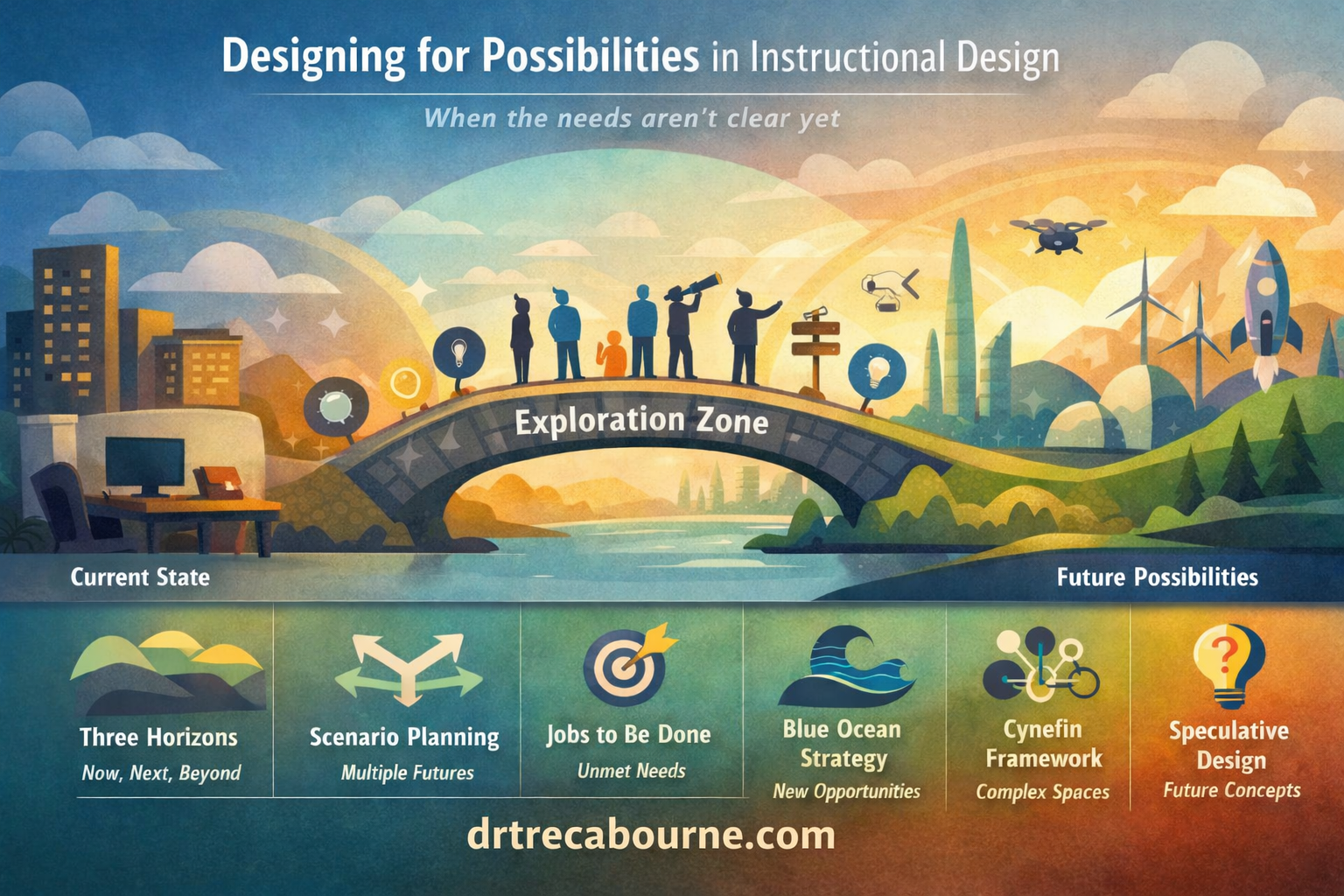
Designing for Possibilities in Instructional Design When Needs Are Not Yet Clear

An illustrated infographic titled “Designing for Possibilities in Instructional Design: When the needs aren't clear yet.” The image shows people standing on a bridge labeled “Exploration Zone,” moving from a city-and-desk scene labeled “Current State” toward a futuristic landscape with wind turbines, drones, and rockets labeled “Future Possibilities.” Along the bottom, six models are listed with icons: Three Horizons, Scenario Planning, Jobs to Be Done, Blue Ocean Strategy, Cynefin Framework, and Speculative Design. The question “What outcomes would be possible with new ways of thinking about learning?” appears at the bottom, along with the website drtrecabourne.com.

Instructional design models typically assume that learners, clients, or stakeholders can articulate what they need. ADDIE, Design Thinking, needs assessment, and task analysis all work well once goals are understood and outcomes can be described. There is another category of work, however, that is increasingly relevant for instructional designers: the work that happens before people …

Shadow leadership: When organizations rely on work they have not built structures for

Image of a woman facing a window with a visible shadow on the wall next to her

Shadow leadership tends to appear in organizations that have not created the roles, pathways, or decision structures needed for the work they expect people to carry. It shows up quietly. Someone becomes the person others turn to, not because the system formally positioned them that way, but because they are competent, reliable, and willing to …

Designing Conditions for Responsible and Effective AI Use in Learning and Work

Image representing workflows

We often hear that “students are cheating,” “employees are cutting corners,” or “people are getting lazy.” But these behaviors rarely happen in isolation. They emerge from the conditions surrounding the learner, the worker, and the task. In learning and development, we know that behavior is shaped more by systems and incentives than by knowledge alone …