

Psychological Safety as a Common Good: Why We Must Stop Competing for It

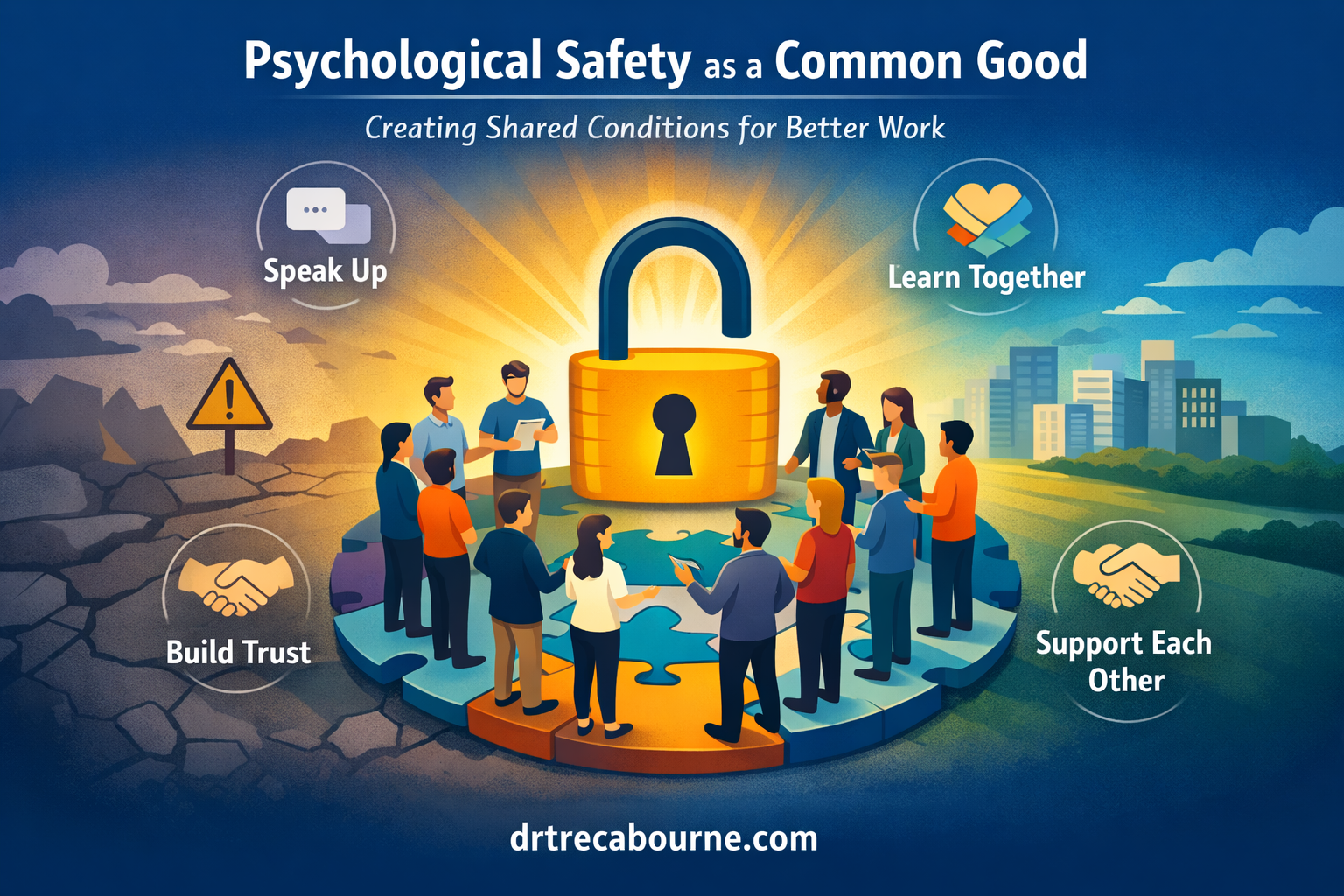
An illustrated scene shows a diverse group of professionals standing in a circle on large puzzle pieces, gathered around a large unlocked golden padlock that glows with light, symbolizing shared psychological safety. To the left of the group, the landscape looks cracked and barren with a caution sign, representing scarcity and threat. To the right, the landscape transitions into a bright city skyline with green space, symbolizing collaboration and possibility. Four circular icons surround the group with short phrases: “Speak Up,” “Learn Together,” “Build Trust,” and “Support Each Other.” Text at the top reads “Psychological Safety as a Common Good” with the subtitle “Creating Shared Conditions for Better Work.” At the bottom is the website “drtrecabourne.com.”

Psychological safety is usually described as a shared belief that it is safe to speak up, ask questions, admit mistakes, or raise concerns without fear of embarrassment or retaliation. But in workplaces where the environment communicates scarcity, threat, or instability, psychological safety can start to feel like a limited resource that people must individually secure …