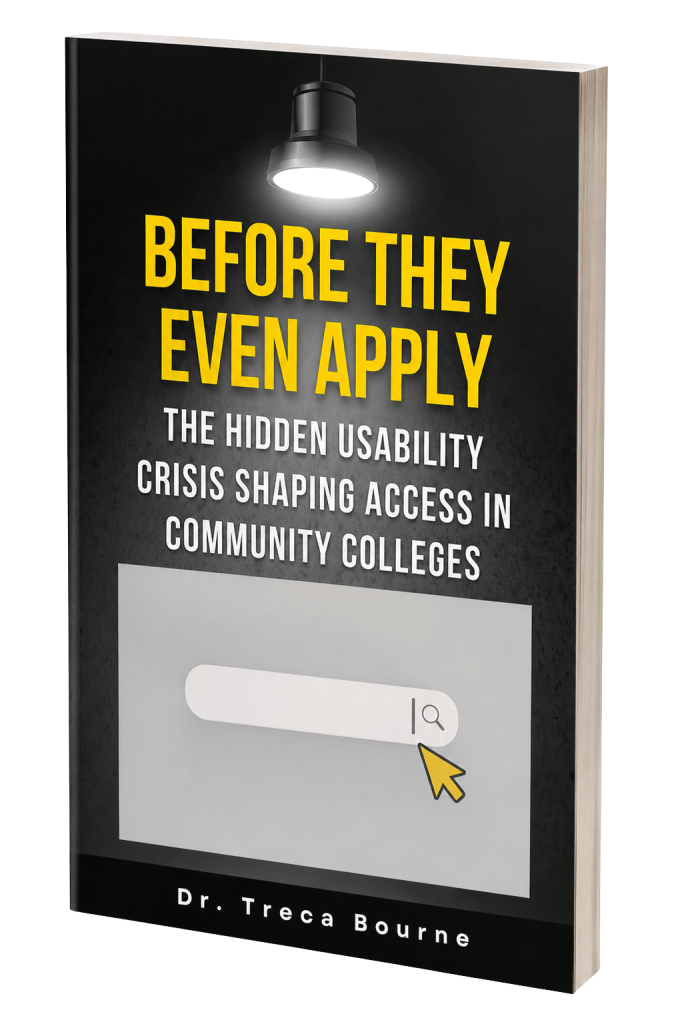
Before They Even Apply: The Hidden Usability Crisis Shaping Access in Community Colleges examines how confusing digital admissions systems quietly block students long before they ever reach a classroom. Drawing from doctoral research, professional practice, usability evaluation of 62 community college applications, and composite student narratives drawn from recurring patterns, the book shows how online applications, websites, and intake systems create unnecessary barriers for first-generation students, adult learners, low-income applicants, and anyone unfamiliar with higher education language and processes.
The book provides a practical, plain language exploration of usability principles as they appear in real institutional systems. Through concrete examples, it demonstrates how design choices influence student confidence, persistence, staff workload, and institutional effectiveness. Issues such as unclear terminology, fragmented navigation, mobile barriers, and poor error messaging are examined as human experiences with real consequences for access and equity.
Written for community college leaders, enrollment and student success professionals, technology teams, organizational learning and workforce development practitioners, faculty, researchers, and policymakers, the book offers realistic strategies for diagnosing usability problems and improving admissions systems within existing resource constraints. Readers gain tools for evaluating digital pathways, prioritizing improvements, and aligning system design with institutional mission.
At its core, the book centers access as a lived experience shaped by everyday design decisions. When colleges design admissions systems with clarity, dignity, and care, they strengthen trust, equity, and opportunity for the students they serve.

Intake Usability Toolkit: A Practical Assessment Guide for Enrollment and Student Success Professionals is for practitioners who are ready to act. Every year, students who are ready and willing to begin college quietly abandon the process before anyone at the institution knows they tried. They do not call to explain. They do not send an email. They simply stop, often because the online admissions application was too confusing, too frustrating, or too unwelcoming to complete on their own.
This toolkit gives your team the tools to find those barriers and fix them.
The Intake Usability Toolkit is a practical, research-grounded assessment instrument developed as a companion to Before They Even Apply: The Hidden Usability Crisis Shaping Access in Community Colleges by Dr. Treca Bourne. It translates nearly a decade of usability research, including a study of 62 community college admissions applications, into a structured, six-section guide that any institution can use, regardless of technical expertise or budget.
What you will assess: The toolkit walks evaluators through ten dimensions of usability drawn directly from documented research findings: whether your application is easy to find, whether it speaks in plain language that students understand, whether navigation is predictable, whether errors are prevented and recoverable, whether the process works on a smartphone, and whether students can access help when they need it.
What you will produce: A severity score for each dimension, a summary scorecard identifying your highest-priority areas, a 30/60/90-day action plan, and discussion questions designed to bring your team into the conversation.
Who this is for: Enrollment management and admissions staff. Student success and advising professionals. IT and web teams. Institutional leaders and trustees. Faculty involved in onboarding. Researchers and graduate students conducting usability or access studies.
You do not need a background in technology or user experience design to use this toolkit. You need to care about whether your systems are actually working for the students you are trying to serve.
A companion to Before They Even Apply by Dr. Treca Bourne. Part of the Community College Usability Series.
