A Self-Care and Well-Being Framework for Intentional Self-Awareness, Healthy Growth, and Holistic Living
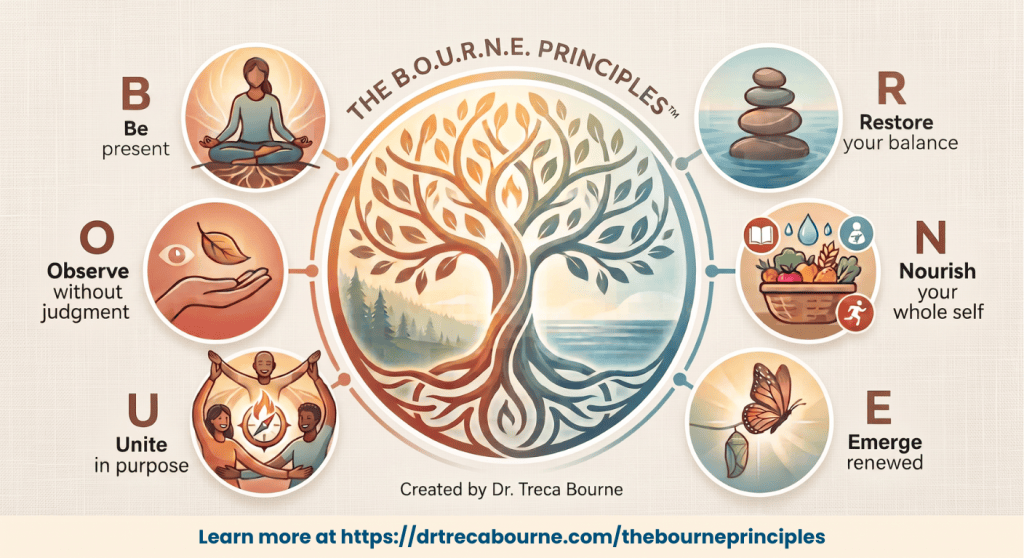
The B.O.U.R.N.E. Principles™ is a guiding framework designed to help you step into intentional self-awareness, healthy growth, and holistic living for greater balance. Rather than striving for perfection, it invites you to actively create the conditions that support thriving through mindful choices, meaningful connections, and sustainable practices.
Developed by Dr. Treca Bourne, the framework brings together insights from mindfulness, positive psychology, self-compassion research, resilience science, and holistic well-being. It serves as both a personal practice and a guiding philosophy for learning experiences, retreats, community gatherings, leadership development, and wellness initiatives.
At its core, the framework recognizes that well-being is an ongoing process of becoming.
What Does B.O.U.R.N.E. Stand For?
B: Be Present
Cultivate presence through mindfulness, breathwork, and grounded awareness. Growth begins when we fully engage with the present moment rather than becoming consumed by the past or preoccupied with the future.
This principle is rooted in mindfulness research, particularly the work of Jon Kabat-Zinn, who defines mindfulness as paying attention intentionally, in the present moment, and without judgment (Kabat-Zinn, 2017).
O: Observe Without Judgment
Develop deeper self-awareness through reflection, curiosity, and compassionate observation. By noticing thoughts, emotions, and experiences without criticism, we create space for insight, learning, and intentional choice.
This principle reflects both mindfulness and self-compassion research. Kristin Neff’s work highlights the importance of approaching ourselves with awareness and kindness rather than self-judgment (Neff, 2023).
U: Unite in Purpose
Build connection through shared intention, community, and collective growth. Learning, leadership, and personal development deepen when we move forward together rather than in isolation.
Research in positive psychology demonstrates that meaningful relationships are a central component of flourishing and well-being. Martin Seligman’s PERMA model identifies relationships as one of the key building blocks of a thriving life (Seligman, 2018). The emphasis on connection also reflects research on common humanity and belonging as foundations for resilience and compassion (Neff, 2023).
R: Restore Your Balance
Honor the necessity of rest, recovery, and nervous system regulation. Through restorative practices, intentional pauses, retreats, and recovery, we create the conditions that allow us to recharge physically, mentally, and emotionally.
This principle is informed by resilience research and contemporary understanding of autonomic nervous system regulation, including Polyvagal Theory, which emphasizes the relationship between physiological regulation, feelings of safety, and well-being (Porges, 2025).
N: Nourish Your Whole Self
Support your mind, body, and spirit through movement, restorative sleep, self-care, lifelong learning, and holistic health practices.
The World Health Organization recognizes well-being as encompassing physical, mental, and social dimensions of health and quality of life (World Health Organization [WHO], n.d.). This principle embraces a whole-person approach that builds the sustainable capacity needed for leadership, service, and everyday life.
E: Emerge Renewed
Integrate insights into daily life with resilience, clarity, and purpose. Transformation does not occur through a single experience. It emerges through the consistent application of what we learn about ourselves and the world around us.
This principle aligns with positive psychology’s understanding of flourishing and the ongoing pursuit of meaning, growth, and accomplishment (Seligman, 2018).
The Journey of the B.O.U.R.N.E. Principles™
The B.O.U.R.N.E. Principles™ represent a developmental pathway:
Presence → Awareness → Connection → Restoration → Nourishment → Renewal
Each principle builds upon the one before it:
- Presence creates awareness.
- Awareness creates intentional choice.
- Intentional choice strengthens connection.
- Connection supports restoration.
- Restoration enables nourishment.
- Nourishment creates the capacity to emerge renewed.
Together, these principles provide a practical roadmap for living with greater purpose, resilience, and balance.
Research Foundations
The B.O.U.R.N.E. Principles™ draw inspiration from several evidence-based disciplines:
- Mindfulness and contemplative practice
- Self-compassion research
- Positive psychology and flourishing
- Resilience and recovery science
- Nervous system regulation
- Holistic health and well-being
- Adult growth and transformative learning
While these traditions inform the framework, The B.O.U.R.N.E. Principles™ are an original synthesis that organizes these ideas into a cohesive process for personal and professional growth.
References
Kabat-Zinn, J. (2017, January 11). Defining mindfulness. Mindful. https://www.mindful.org/jon-kabat-zinn-defining-mindfulness/
Neff, K. D. (2023). Self-compassion: Theory, method, research, and intervention. Annual Review of Psychology, 74, 193-218. https://doi.org/10.1146/annurev-psych-032420-031047
Porges, S. W. (2025). Polyvagal theory: A journey from physiological observation to neural innervation and clinical insight. Frontiers in Behavioral Neuroscience, 19. https://doi.org/10.3389/fnbeh.2025.1659083
Seligman, M. E. P. (2018). PERMA and the building blocks of well-being. The Journal of Positive Psychology, 13(4), 333-335. https://doi.org/10.1080/17439760.2018.1437466
World Health Organization. (n.d.). Health and well-being. https://www.who.int/data/gho/data/major-themes/health-and-well-being
World Health Organization. (n.d.). Promoting well-being. https://www.who.int/activities/promoting-well-being
Trademark Notice: The B.O.U.R.N.E. Principles™ is a trademarked framework developed by Dr. Treca Bourne. All rights reserved.
Stay Connected
I’d love for you to join this growing community. Subscribe to receive updates about events, blog posts, and new opportunities to learn, restore, and grow.

